
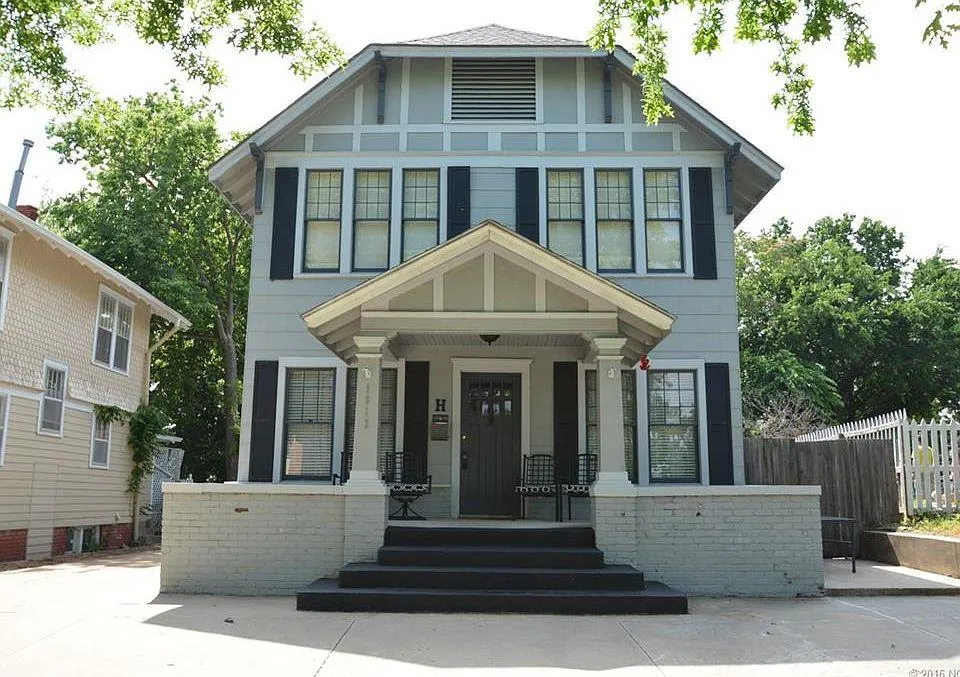
How to Choose an Investment Property in Tulsa, OK

How to Choose the Right Investment Property in Tulsa, Oklahoma: Zoning, Financing, Cash Flow & Exit Strategies
The best investment property isn't necessarily the cheapest house, the one with the highest advertised return, or the property a lender is willing to finance. It's the property that fits your investment strategy, meets local regulations, produces the right numbers, and gives you a profitable exit.
Tulsa, Oklahoma, offers investors opportunities ranging from traditional single-family rentals and duplexes to multifamily properties, short-term rentals, fix-and-flips, and specialized housing arrangements.
But there's one thing investors sometimes overlook until it's too late: Just because you can purchase a property doesn't mean you can legally use it the way you intended. Understanding zoning, property restrictions, financing requirements, and your exit strategy before you make an offer can save you thousands of dollars and prevent you from purchasing a property that doesn't fit your investment goals.
As a mortgage broker who works with real estate investors, I believe my responsibility goes well beyond finding you a loan and collecting a commission. I want to understand your strategy, evaluate the financing options, and help you build a portfolio that makes financial sense today and years from now.
Let's look at how to approach investing in Tulsa.
1. Start With Your Investment Strategy, Not the Property
Before we start looking at interest rates or properties, I want to understand what you're trying to accomplish. Are you looking for monthly cash flow? Long-term appreciation? A quick renovation and resale? Or are you building a portfolio that will eventually replace your current income?
Different strategies require different properties, financing structures, and exit plans.
Investment strategy | What to evaluate |
Buy and hold | Market rents, expenses, tenant demand, long-term cash flow |
Fix and flip | Acquisition price, renovation costs, ARV, holding costs, resale demand |
BRRRR | Purchase, rehab, stabilized value, refinance seasoning, cash-out potential |
Short-term rental | Licensing, occupancy rules, seasonal revenue, management expenses |
Multifamily | Legal unit count, zoning, vacancy, operating income |
Room-by-room rental | Occupancy classification, rental structure, parking, applicable zoning |
Group or recovery housing | Permitted use, resident arrangements, fire and building requirements |
For example, a property might be an excellent fix-and-flip but a terrible long-term rental. Another might have attractive room-by-room income potential but require approvals that change the entire financial picture. My goal is to help you find the financing that supports the investment strategy, rather than force your investment into a loan program that doesn't fit.
2. Understand Tulsa's Zoning Laws Before Purchasing
Tulsa's zoning regulations are especially important for investors considering duplexes, multifamily housing, short-term rentals, room rentals, or group housing. The City of Tulsa Zoning Code, Title 42, identifies the residential districts, permitted property uses, development standards, and circumstances requiring special approval.
Two zoning districts worth understanding are RS-3 and RM-3.
RS-3: Residential Single-Family 3
RS-3 is primarily a single-family residential district. For an investor, an RS-3 property may be well suited for a traditional single-family rental, but the zoning designation does not automatically authorize converting a house into multiple independent apartments or operating every form of shared housing.
Investors should review:
Whether the existing building and number of dwelling units are legal.
Whether an additional dwelling unit or conversion is permitted under current rules.
Whether room rentals constitute household living, a multi-unit house, or another regulated use.
Whether a proposed short-term rental meets licensing requirements.
Whether neighborhood overlays, deed restrictions, or other rules limit the intended use.
A five-bedroom home with attractive room-rental projections might look profitable on paper. However, the rental arrangement and building classification must be confirmed before relying on five separate rental contracts.
RM-3: Residential Multi-Family 3
RM-3 is Tulsa's most intensive standard residential zoning district on the residential intensity scale. It generally provides greater opportunities for multifamily residential development and a wider variety of housing configurations than RS-3, subject to the permitted-use tables, building-type regulations, and site-specific standards.
For investors, RM-3 may be particularly relevant when evaluating apartments, multifamily redevelopment, and certain higher-density residential strategies. However, RM-3 does not mean every residential or commercial use is automatically allowed. Building height, lot size, density, parking, setbacks, overlays, and use-specific rules can still affect a project.
The applicable code provisions include Chapter 5, Sections 5.020 and 5.030, and the supplemental regulations in Chapter 40.
3. RS-3 vs. RM-3: Which Zoning Works for Your Investment?
Consideration | RS-3 | RM-3 |
Primary residential character | Single-family | Higher-intensity multifamily |
Traditional single-family rental | Generally permitted | Generally permitted in an allowed building type |
Multifamily development | Limited; verify specific allowances | Broader opportunities, subject to standards |
Short-term rental | City license required | City license required |
Room-by-room renting | Depends on actual use and classification | Depends on actual use and classification |
Group or recovery housing | Specific classification and rules apply | Specific classification and rules apply |
Investment flexibility | Typically more limited | Typically greater |
A key distinction: a zoning district determines what types of uses and structures may be allowed. It does not guarantee that a particular property is already legally configured for those uses.
Tulsa's zoning code uses P for uses permitted by right, S for uses requiring special-exception approval, and a dash for prohibited uses. Investors need to review the exact use category rather than assume that a general residential designation covers their business model.
4. Tulsa Investment Property Zoning Map: Where Are RS-3 and RM-3 Areas?
Official City of Tulsa Zoning Map
Use the city's parcel-level map to distinguish RS-3, RM-3, and other zoning districts. The zoning boundaries are too detailed to accurately represent with neighborhood-wide pins.
From the map portal, select the City of Tulsa Zoning Map. Search an address and inspect its zoning designation, boundaries, and overlays.
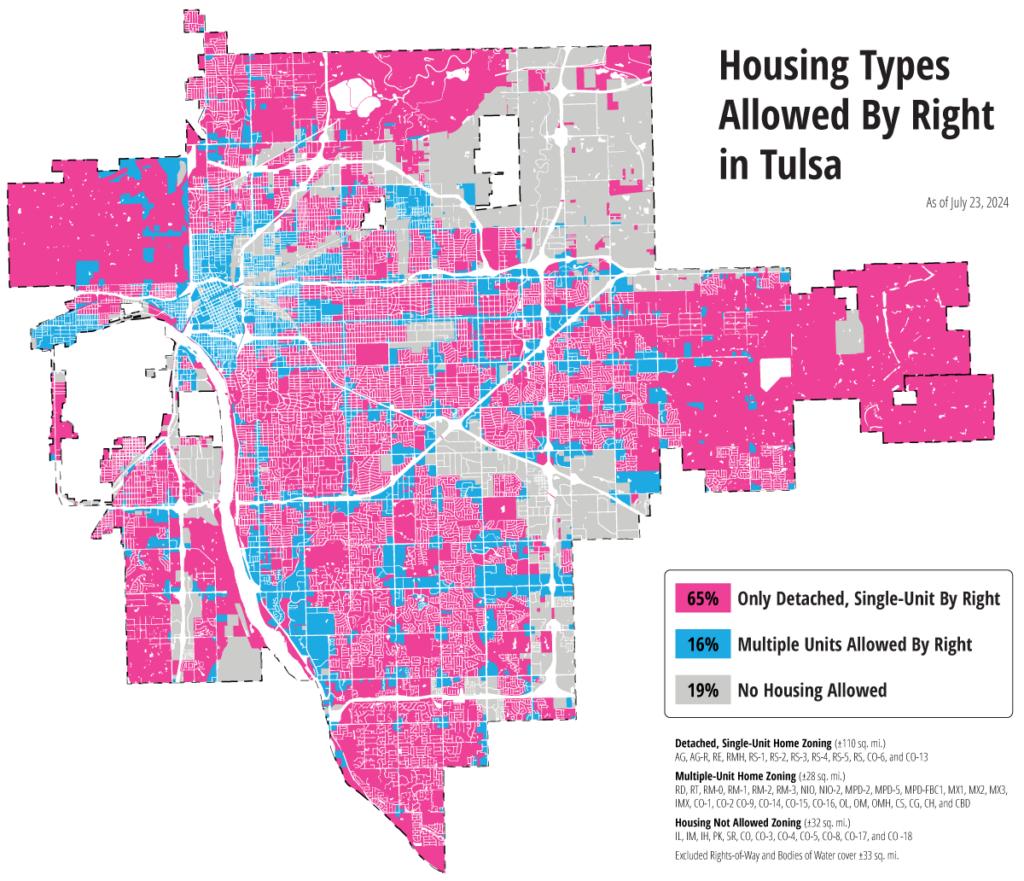
The most important thing to understand about this map is that zoning can change from one parcel to the next, even on the same street.
When evaluating a potential purchase, I recommend confirming the zoning designation directly with Tulsa Planning and obtaining written clarification when the intended use is unusual or uncertain. Don't rely exclusively on what a listing agent, seller, property manager, or previous owner tells you. You can also review the city's full zoning code and its official mapping resources.
5. Special Considerations: Short-Term Rentals, Room Rentals, and Group Housing
This is where choosing the right property becomes especially important.
Short-term rentals
Tulsa allows short-term rentals in all zoning districts, but operators must obtain a city short-term rental license before advertising or renting a dwelling for periods shorter than 30 days.
According to the city's published guidance, the rules include an eight-person maximum occupancy per rental unit, potentially lower based on square footage, a local contact requirement, and restrictions on events. Applicable private covenants can create additional limitations.
A short-term rental investor also needs to analyze seasonality, cleaning, furnishing, utilities, management fees, lodging taxes, and the property's performance as a long-term rental if the short-term strategy stops working.
Room-by-room rentals and boarding houses
A home that rents for $1,600 per month as a traditional rental might appear capable of generating $3,000 per month when rented by the bedroom. But that higher income does not automatically translate into a better investment.
Investors must establish whether the arrangement qualifies as household living, a multi-unit house, boarding or rooming use, or another regulated classification. The applicable zoning, occupancy, building, parking, and fire-safety requirements may differ.
Financing can also be more complicated. Some DSCR lenders require a conventional market-rent appraisal rather than accepting the sum of individual room rents. Others may consider specialized rental arrangements with additional documentation.
Group homes and sober living properties
Group housing is especially important to evaluate correctly because the applicable rules may depend on the residents, services provided, occupancy, and legal classification of the use. Tulsa's code includes regulations for community group homes and group living uses in Chapter 40, including Sections 40.100 and 40.160.
Federal fair-housing protections may also apply to certain disability-related housing arrangements. Those protections must be considered alongside local requirements rather than assuming ordinary single-family or multifamily rules answer every question.
For these investments, I recommend written zoning confirmation and appropriate legal review before making a nonrefundable commitment.
The takeaway: Don't build your projected return on rental income that the property cannot legally or practically generate.
6. Run the Numbers: Cash Flow, DSCR, and Actual Profitability
Finding a property with strong rental demand is only half the equation. The numbers have to work after accounting for the actual costs of ownership. I want investors to look beyond the monthly mortgage payment and calculate their true operating expenses.
A property may look excellent when evaluated using gross rent alone. But after accounting for vacancies, repairs, insurance, taxes, management, and financing costs, the return may look very different.
For short-term rentals, we should examine revenue estimates from sources such as AirDNA, but compare those projections against real operating expenses and a conservative occupancy scenario. For fix-and-flips, the important numbers include the purchase price, after-repair value, renovation budget, carrying costs, selling costs, and projected profit.
And for BRRRR investors, I want to know whether the projected refinance will actually return the capital you're expecting after lender loan-to-value limits, seasoning requirements, appraisal results, and closing costs.
7. Your Exit Strategy Matters Just as Much as Your Purchase
One of the biggest mistakes an investor can make is focusing entirely on getting into a property without thinking about how to get out. Your exit strategy influences which loan is appropriate from the very beginning.
For example, if you're planning to refinance a property in six months, taking a loan with a substantial prepayment penalty could undermine your strategy. If you're renovating a property and expecting to refinance based on its new appraised value, title seasoning and cash-out guidelines can become critical.
If you're buying a short-term rental, what happens if bookings fall by 30%? Could the property still work as a long-term rental? I want every investor to consider at least three possible outcomes: the property performs as planned, the investment takes longer than expected, or market conditions change and you need an alternative exit.
A solid investment should not depend entirely on everything going perfectly.
8. Why Your Mortgage Broker Matters: Not Every Lender Has the Same Buy Box
Here's something I tell investors all the time:
You have a buy box. Lenders have a buy box, too. Your buy box might include a specific purchase price, property type, neighborhood, cash-flow target, and investment strategy. A lender's buy box is different. It includes the types of properties, borrowers, credit profiles, income sources, and transaction structures they're willing to finance. The problem is that those two buy boxes don't always line up.
You might find the perfect investment property, only to discover your lender doesn't finance manufactured homes, rural properties, room-by-room rentals, certain short-term rentals, or properties with unusual characteristics.
Or perhaps the lender requires a higher credit score, more reserves, or a different appraisal method than your deal can support. That's where working with an experienced mortgage broker can make a tremendous difference.
Access to more than 50 lenders
I have relationships with over 50 lenders, each with different programs, pricing, guidelines, and appetites for investment properties. My job is to know those lenders, understand their guidelines, and stay informed when those guidelines change.
Instead of sending you out to shop lender after lender, I do that work for you. That means we're not just looking for the lowest advertised interest rate. We're looking for the right combination of financing, property eligibility, fees, flexibility, and exit strategy. Some lenders specialize in traditional DSCR loans.
Others may offer options for fix-and-flips, construction, rural properties, manufactured homes, or unusual rental-income situations. Having access to multiple lenders doesn't guarantee every deal can be financed. It does give us more opportunities to find a program that fits.
One credit report, multiple lender options
Another benefit of working with my team is that we generally obtain one mortgage credit report that can be used with participating lenders for up to 120 days, subject to their individual requirements.
If a lender changes its guidelines or the transaction needs to move to another lender, we can often transfer the file and supporting documents rather than making you start completely from scratch. A new lender may still require updated credit or other documentation, but the goal is to minimize unnecessary delays.
Why I don't believe in being an order taker
I sometimes get messages like this:
"Can you get me a 6.5% DSCR loan with no points and low fees?"
I understand the question. Everyone wants a great rate and low closing costs. So do I. But here's what I want investors to understand: A great interest rate on the wrong loan is not a great deal. Before I can tell you what financing makes the most sense, I need to understand your goals, the property, and you as the borrower or guarantor.
Are you planning to sell in six months? Hold the property for ten years? Refinance after renovations? Build a portfolio of 20 properties? Does the property have a current lease? Is it vacant? Are you planning to rent it by the bedroom? Is the projected income realistic?
Those details can completely change my recommendation. I don't want to be the person who simply takes your order and closes your loan. I want to be the professional who helps you think through the deal before you commit.
9. The Discovery Call: Where a Successful Investment Begins
Every investment transaction starts with a conversation. During our initial discovery call, I want to understand three things: you as an investor, the property you're considering, and your short-term and long-term goals.
Some of the questions we discuss include:
Your credit profile, late payments, homeownership status, liquidity, and available reserves.
Whether the property is a single-family home, multifamily property, manufactured home, or rural property.
Whether it's leased, vacant, or being renovated.
Whether you're using traditional rental income, short-term rental income, or individual room rents.
Your anticipated purchase price, renovation budget, and after-repair value.
Your cash-flow expectations, projected ROI, and the source of those numbers.
Whether you're pursuing a BRRRR strategy, a flip, or a long-term hold.
Whether the loan has prepayment penalties, seasoning restrictions, or other limitations.
How many properties you ultimately want to own.
We also discuss insurance early. Coverage and cost can vary substantially based on the property, its condition, and its intended use. For example, a property being operated as a group home or specialized rental may have different insurance considerations than a conventional single-family rental.
I want to identify these issues before we're days away from closing.
10. Why Repeat Investors Work Differently With My Team
My business is built on repeat clients and referrals. Many of my investor clients come back to me again and again because they know I already understand their goals, their preferred investment strategies, and the types of financing that work for them.
We keep their files organized, maintain the relevant documentation, and update information as needed for future transactions. We don't need to reinvent the wheel every time they find another property. Once I know your buy box, your goals, and your financial profile, the process becomes more efficient.
You find the next opportunity. We review the deal, identify the financing options, update the documents, and move forward. It's a relationship designed to grow alongside your portfolio.
11. Our Service Standards: What We Expect From Investors
My team and I take client service seriously. We also believe successful transactions require a commitment from both sides. Our goal is to maintain a 30-day closing process whenever the transaction and loan program allow it.
To do that, we need investors who respect deadlines, respond to documentation requests, and communicate with us throughout the transaction. Here's what you can expect when working with us:
Our commitment to you: We will work to identify competitive financing, explain your options, communicate clearly, stay informed about lender requirements, and help keep the transaction moving.
Your commitment to us: Once you've decided to move forward, we expect timely responses, complete documentation, honest communication, and respect for the work our team is performing.
We understand investors want to compare rates and fees. That's reasonable. But interest rates can change daily, sometimes multiple times in the same day. Comparing a quote from Monday with a different lender's quote from Thursday doesn't necessarily tell you which financing option is better.
If you're still shopping lenders, we encourage you to complete that process before committing to a full loan application with our team. Once we begin working together, we're committing professional resources to your transaction.
If communication stops during the process, we may place the file on hold for one week. That can delay your closing by at least a week. If we're still unable to reach you, we may withdraw the application from active processing, subject to applicable requirements and notices.
These expectations aren't intended to make the process difficult. They're how we protect our ability to provide the same high level of service to every client. We want serious investors who value a professional relationship, not just a transaction.
12. Your Tulsa Investment Property Checklist
Before committing to a property, make sure you've reviewed the following:
Investment due diligence
Confirm parcel zoning and the legal use of the property
Check RS-3, RM-3, or other applicable district restrictions
Review overlays, private covenants, permits, and occupancy rules
Verify current leases, rental comps, and projected income
Estimate insurance, property taxes, vacancy, repairs, and management
Calculate cash flow, DSCR, and return on invested capital
Confirm lender property eligibility and credit requirements
Review prepayment penalties, seasoning, and refinance options
Create primary and backup exit strategies
Complete a financing discovery call before committing
13. Final Thoughts: Build a Portfolio, Not Just a Collection of Properties
There are plenty of people who can quote you an interest rate. There are plenty of lenders who can tell you whether you qualify for a loan. What I want to offer is something different. I want to understand what you're building.
Whether you're purchasing your first rental property in Tulsa, adding your tenth property, or working on a more complicated investment involving DSCR financing, renovations, short-term rentals, or specialized housing, my goal is to help you make informed decisions.
I want to help you consider the purchase, the financing, the profitability, and the exit strategy. Because the goal isn't simply to get you to the closing table. The goal is to help you build a profitable, sustainable investment portfolio that you'll want to keep growing. And when you're ready for the next property, I want to be the first person you call.
Sources and regulatory references
This article uses Tulsa's official planning and licensing resources. The city's zoning code currently published online is amended through October 21, 2025.
City of Tulsa Zoning Code — Chapter 5 (residential districts), Chapter 20 (overlays), Chapter 35 (use classifications), Chapter 40 (supplemental regulations).
Tulsa Planning Official Zoning Maps — parcel-level zoning and property information.
City of Tulsa Short-Term Rental Rules — licensing, occupancy, and operating requirements.
Tulsa Planning FAQ — how to verify zoning and seek special-exception approval.